« Back to Resource Hub

How charities can use framing techniques to create values-led stories

Jodie is a white woman with medium blonde hair and pink thin rimmed glasses. She is smiling at the camera.

18 March 2026

by Jodie Hoskin-Mobbs

Marketing Manager at Media Trust.

Why great messages don’t always land, and what your charity can do instead.

If you work in charity comms, you’ve probably thought ‘If people really understood this issue, they would care more.’ We’ve all been there, I know I certainly have. To encourage understanding from new and existing audiences, we often put huge effort into:

  • Clearer explanations
  • Stronger statistics
  • Myth‑busting content
  • Urgent messaging

But often, we still find that people don’t respond to our content the way we might expect. The problem usually isn’t what you’re saying, it’s how the message is framed.

Inspired by Ruth Taylor’s guest webinar on framing and values for Media Trust, this resource will help you spot when ineffective framing is getting in the way of your message landing. We’ll show you how to fix the messages that aren’t working and introduce you to the world of values-based communications.

Why information alone doesn’t always change behaviour

Many of us were taught (directly or indirectly) that if people have the right information, they’ll act on it. But human brains are far more complicated than that.

In practice:

  • We pay more attention to information that fits what we already believe
  • We’re quicker to dismiss facts that feel uncomfortable or threatening
  • We often make decisions based on how something feels, not how accurate it is

That’s why people can still hold wildly inaccurate views on issues like poverty, immigration or climate change, even after years of great awareness raising campaigns and expert evidence.

For charities, this matters because adding more facts or explaining harder doesn’t always lead to more understanding. Sometimes it can lead to pushback, overwhelm, or disengagement.

What is framing and why it matters

Framing starts from a really simple idea that we are never communicating in a vacuum. People don’t come to your messaging and comms with an empty mind. Rather, they bring their own experiences, assumptions, worries and beliefs with them.

Framing is about recognising this and choosing how your message shows up with all these considerations in mind. Another way to think about it is that framing is choosing which ideas and feelings your message brings to the surface.

It’s important to remember: There’s no such thing as an unframed message. Every message triggers associations with an audience. The only question is whether you’ve chosen them intentionally or left them to chance.

Whether we work in communications or not, we already use frames all the time. When you hear words like ‘school’, ‘family’ or ‘home’, a whole set of ideas and feelings appear instantly. Your charity’s messaging works in exactly the same way.

How good framing can tackle misinformation

When we see misinformation or harmful narratives about our charity’s cause, our instinct is often to correct them head‑on. That’s how we end up with messages like:

  • Homelessness is not a lifestyle choice
  • Immigrants are not the enemy
  • This issue isn’t about personal failure

These statements are correct and very well‑intentioned, but they can accidentally reinforce the myth that we’re trying to dispel.

When we repeat a harmful idea, even to argue against it, we bring it back into people’s minds. The brain tends to remember the idea itself, not the correction. So instead of moving people forward, we can end up reinforcing the very thing we’re trying to undo.

What should we do instead?

Say what you want people to think, not what you want them to stop thinking.

For example:

  • ‘Homelessness is not a lifestyle choice’ becomes: ‘Everyone deserves a safe, stable place to live.’
  • ‘Immigrants are not the enemy’ becomes: ‘Immigrants are welcome here.’

It’s a bit like signage at a swimming pool. ‘Don’t run’ can put the idea of running in your head, whereas ‘please walk” tells you clearly what to do.

Why values make messages land better

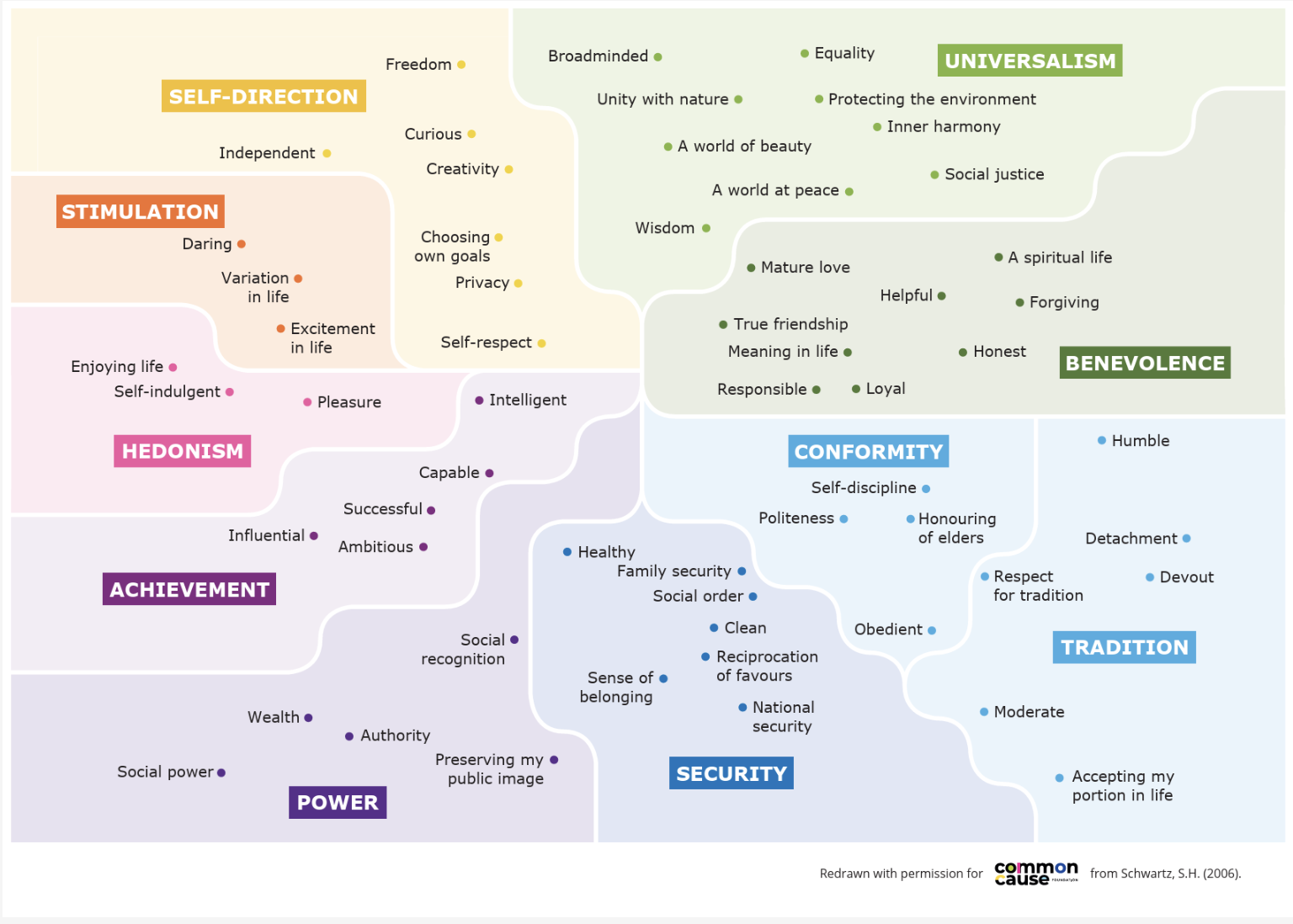
Research from the Common Cause Foundation shows that people across cultures tend to share a common set of values, but we prioritise them differently depending on context and messaging.


Colourful diagram showing ten human value groups arranged in a circular map, where values placed closer together are more compatible and those further apart may conflict. Groups include Universalism, Benevolence, Conformity, Tradition, Security, Power, Achievement, Hedonism, Stimulation and Self-Direction.

This diagram shows ten groups of human values: Universalism, Benevolence, Tradition, Conformity, Security, Power, Achievement, Hedonism, Stimulation and Self-Direction, arranged in a circular map. Values placed close together are more closely related, while those further apart are more likely to conflict. It shows how the values we prioritise can shape our attitudes and behaviour.

The Common Cause values map groups values into different types. Two are especially important for charities to understand:

Intrinsic values

These are values focused on care, connection and shared humanity. They include things like:

  • Caring for the wellbeing of others
  • Fairness and social justice
  • Protecting people and the planet

When messages activate these values, people are more likely to:

  • Feel open rather than defensive
  • Care more deeply and consistently
  • Support long‑term social change

UK charities often put these intrinsic values into action in the way they communicate their mission. For example, Trussell frames its work around the idea that ‘no one in the UK should need a food bank to survive’ and that everyone deserves enough money to afford life’s essentials. This emphasises collective support and fairness, rather than just presenting statistics about food insecurity.

This kind of framing helps audiences see food poverty not as an individual failure, but as something society can work together to solve.

Extrinsic values

These are values focused on status, image and external rewards, such as success, power or recognition.

Messages that lean heavily on these values can:

  • Encourage short‑term action
  • But weaken people’s sense of connection and collective responsibility

This doesn’t mean extrinsic values never show up in charity comms, but research suggests that training audiences to think in intrinsic, shared‑human values leads to more lasting engagement.

You don’t need to talk about values explicitly. You just need to frame your messages in ways that reflect care, dignity and shared experience.

Why hope‑based messaging works better than fear alone

Understandably, a lot of charity messaging can focus on crisis and urgency. And sometimes that does grab attention.

But over time, too much fear‑based messaging can leave people feeling overwhelmed, guilty and unsure where to start. Hope‑based messaging isn’t about pretending everything is fine. But it is about showing that change is possible and helping people imagine a future that’s worth moving towards.

A useful thing to remember: Urgency without hope can often lead to decision and analysis paralysis. Hope can give people somewhere to look and work towards.

What does hope-based messaging look like?

Some environmental charities have shifted their messaging in recent years to balance urgency with hope.

For example, WWF frames its solutions work around the idea that ‘there’s still time to bring our world back to life’, emphasising collective action and practical steps people and organisations can take.

Similarly, Friends of the Earth uses language about building fairer, greener communities, talking about ‘clean air, warmer homes and greener jobs for everyone’, showing how climate action connects to everyday wellbeing and shared futures.

This kind of framing helps audiences feel that change is possible, rather than leaving them overwhelmed.

A simple way to structure your messages

Now that you know about framing, it’s important to know that you don’t need to rewrite everything from scratch. This structure below works for your charity’s existing or future social posts, emails, webpages and campaign messages.

1. Start with a shared value

Something most people can agree with.

Example: ‘We all want children to have the best start in life.’

2. Name the problem (briefly)

Keep it clear and focused.

Example: ‘But right now, many families can’t access the support they need.’

3. Show a hopeful outcome

Help people see what could be different.

Example: ‘With the right services in place, families can get help early and children can thrive.’

4. Invite action (if it makes sense)

Only include this when it’s useful.

Example: ‘That’s why we’re calling for…”

Tip: If you do just one thing differently from reading this resource, try to move more quickly from problem to hope in your charity’s comms.

You don’t need to change everything at once. Small changes in how you frame your messages can make a noticeable difference.

A good place to begin could be:

  1. Take one recent social post, email or webpage paragraph
  2. Remove any defensive or myth‑busting language
  3. Start with a shared value
  4. Move to a hopeful, human outcome

Key takeaways on framing

Your charity may not need more facts, or more urgent messaging.

What it may need is:

  • Clearer framing
  • Shared, intrinsic values
  • Messages that help people feel connected and hopeful

We hope this introduction to values and hope-based messaging will help your charity do just that.

Was this resource helpful?

Related Resources

Burnout prevention and self-care for busy charities

If you work in charity communications, you probably wear more hats than your job title suggests. One minute you’re drafting a press release, the next you’re troubleshooting on social media, updating the website and pulling...

Posted 11 March 2026

A group of 3 people sit on a workplace sofa with plants in the background, smiling and with mugs in hand. They speak to another person who is only slightly in the shot, also holding a mug.