Your charity’s numbers might be telling you the wrong story
Learn how to look beyond the metrics and make more informed decisions about your charity’s digital strategy
Posted 21 October 2026



5 February 2025
at Be Smart Cookie.

Guide
4 minutes
Join digital doctor Janette Ballard in building your charity’s defence against fake news and learn how pre-bunking can outsmart misinformation before it spreads.
‘Lies make it halfway around the world before the truth has even got it’s boots strapped on.’
Although no one seems 100% sure who first said this, we all know the saying, right? And we know that this is one of the main reasons why it’s hard to correct fake news online. As misinformation travels at light speed across social media and the internet, many of the corrections struggle to catch up.
If your charity is affected by fake news you will know first-hand how misinformation, from distortion to outright untruths, can hurt the individuals you work with. It can mislead the public about the issues you care about and in turn, damage your charity’s reputation.
You may feel there is little or nothing you can do about this, considering the vast scale of misinformation that’s out there. And with Meta’s recent decision to remove fact checkers from their platforms, chaos in the information space has been supercharged, while the ability to debunk it shrinks.
But don’t despair!
Academic research about a particular intervention may offer a good solution: pre-bunking.
Pre-bunking is like a digital version of vaccination in medicine and public health. Vaccines work by exposing the body to a small, weakened does of the disease. The body then builds resistance making it ready to recognise and resist the same hostile invader when exposed to it.
Pre-bunking works the same way. It shows people a small example of misinformation, explains why it’s false, and shares the correct information instead.
Then, when exposed again to the misinformation, those ‘digitally vaccinated’ can recognise the misinformation and are less likely to believe it.

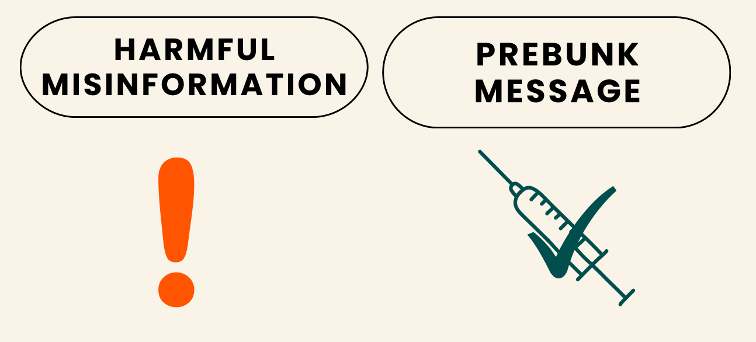

Many organisations already use pre-bunking as a tool to tackle fake news. Piltch-Leob found that people who watched a video addressing misinformation about the COVID-19 vaccine showed greater resistance to similar misinformation than those who had not seen the videos.
Similarly, Google pre-bunked misinformation about Ukrainian refugees across Poland, Czech Republic and Slovakia as a result of Russia’s invasion of Ukraine. To get ahead of anti-migrant hate, Google and partners created six videos designed to prebunk two narratives that had begun to appear online – scapegoating Ukrainian refugees for the rising cost of living, and fear-mongering over the supposedly violent nature of refugees.
Pre-bunking offers a potentially powerful tool for charities to get ahead of misinformation. Rather than spending more money on communications that respond to fake news directly, it’s worth considering diverting the same resource towards strategies that are more likely to achieve proactive results.
Here’s some key questions to help you consider how pre-bunking might work for your charity.
Use your answers to plan, craft and execute the perfect pre-bunking message for your cause.
Pre-bunking won’t be right for every charity, and it may need some time to get the best results. But even if it changes a charity’s response to a press enquiry from ‘We’ll get a quote to you asap…’ to ‘We posted a fact check on this topic a month ago…take a look’, it can help charities demonstrate confidence and provide reassurance in confusing times.
For more information on pre-bunking for charities, take a look at Janette’s simple ‘how to’ guide for how charities can get ahead of fake news.
Download the how to guideLearn how to look beyond the metrics and make more informed decisions about your charity’s digital strategy
Posted 21 October 2026
Creating regular video content can feel overwhelming, especially if you’re working with a small team and limited resources. The good news is that you don’t need expensive equipment, a professional production crew or hours of editing time...
Posted 27 August 2026

Young people are one of the most connected audiences online, but reaching them requires more than simply posting regularly. Young people are increasingly discovering charities through social media, often long before they visit a website,...
Posted 30 July 2026